The Value of a No-Trade Night
The strategy did not give me a trade last night, so I closed the computer with $0 gained and $0 lost. That is still a win for the process.
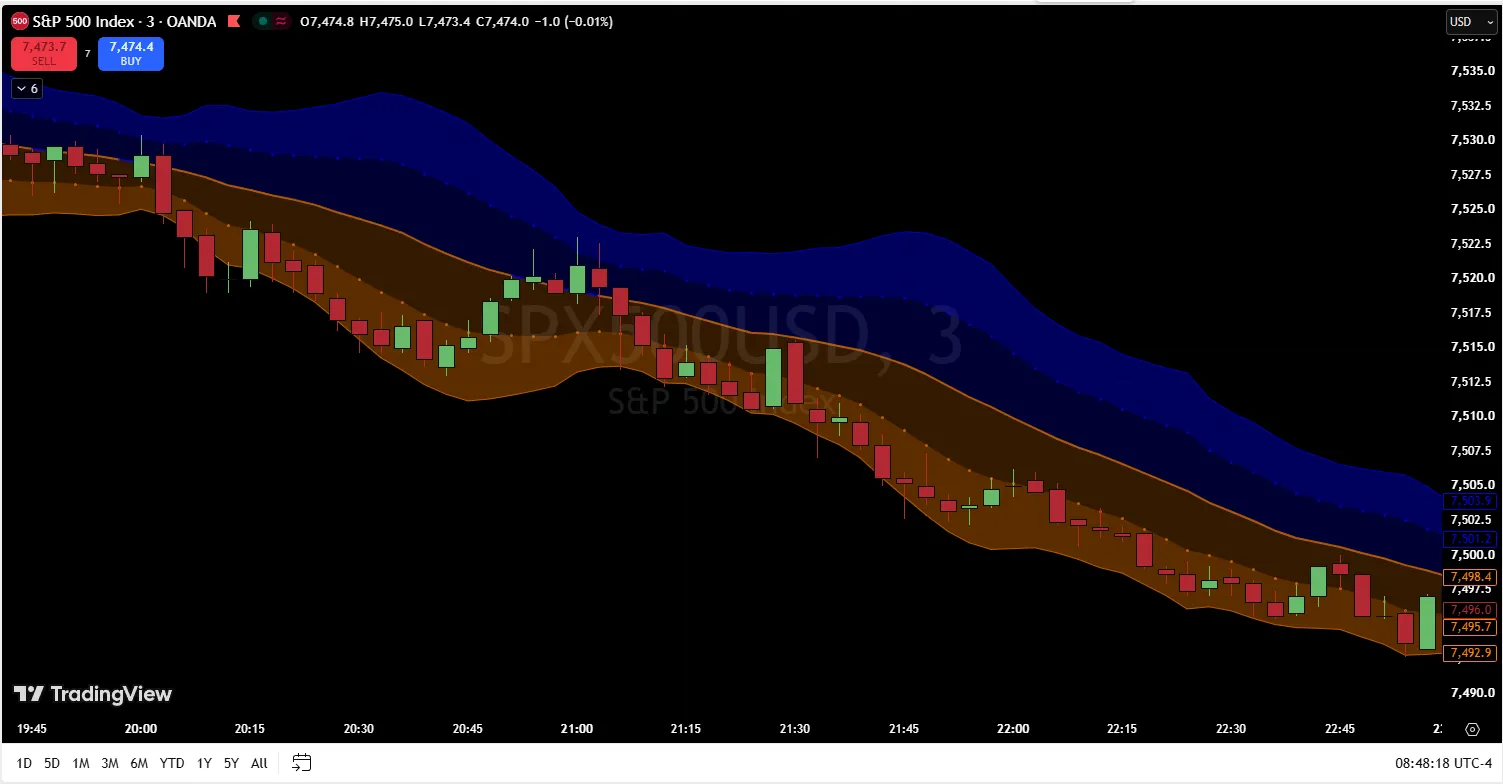
Last night was a no-trade night.
Not because the market was closed. Not because I forgot to open the charts. I was there, watching price move around on the 3-minute chart, waiting to see whether The Tokyo Pipeline would give me something worth taking.
It didn’t.
And honestly, I am starting to see that as a good thing.
There was movement, just not my setup
The chart was not completely boring. Price moved lower through the session, with a few bounces and little moments that could probably look interesting if I zoomed in far enough.
That is part of the problem with staring at charts for too long. Almost any movement can start to look like an opportunity when you want to find one.
But the strategy has rules for a reason. I am looking for a tight range, a move toward one of its absolute edges, and a failed break with enough confirmation to make an entry reasonable. I did not get that sequence last night.
There were candles. There was momentum. There were probably several ways someone could have tried to trade it.
There just was not a trade for me.
The temptation to make something happen
The difficult part of a no-trade session is not usually deciding what to do. It is deciding what not to do.
When you spend time watching the market, it is easy to feel like you should leave with something to show for it. A win would be nice. Even a small win can make the session feel productive. That little voice in the back of your head starts saying things like, “Maybe this candle is close enough,” or, “I could just take a quick one here.”
That is how a strategy slowly stops being a strategy.
If I start bending the rules because I am bored, impatient, or worried that I missed the move, then I am no longer testing The Tokyo Pipeline. I am testing random decisions made while looking at a chart.
Those are two very different things.
$0 gained is also $0 lost
So I closed the computer with a $0 gain.
That might not sound exciting, but it also meant I closed it with a $0 loss. I did not force an entry. I did not turn a quiet session into a revenge trade. I did not create a losing position just so I could tell myself I had been active.
I followed the rules and kept my account exactly where it was.
That matters, especially while I am paper trading and trying to build habits before I ever think seriously about an evaluation. The goal right now is not to trade every session. The goal is to learn whether I can recognize my setup, wait for it patiently, and stay out when it is not there.
Sometimes the result of doing that is a trade that works.
Sometimes the result is no trade at all.
A quiet kind of progress
I think traders, especially new traders, can accidentally measure progress only in dollars. A green day feels like progress, and a red day feels like failure.
But there are other results worth tracking:
- Did I show up when I said I would?
- Did I wait for the setup I am actually testing?
- Did I avoid entering just because I wanted action?
- Did I close the session when my rules gave me no reason to continue?
Last night, the answer to those questions was yes.
That does not make the session profitable, and it does not prove that my strategy works. It is a much smaller victory than that. It simply gives me one more example of following the process correctly.
That is enough for one night.
Back again tomorrow
There will be plenty of time for losses while I learn. There will also be time for wins. Neither one should be allowed to change the rules after the fact.
For now, I am trying to get comfortable with the idea that I do not need to participate in every move. The market will still be there tomorrow, and a missed trade is usually easier to live with than a forced one.
Last night I watched, waited, found no valid setup, and walked away with the same balance I started with.
This is the same process I started documenting in my first journal entry: showing up, following the plan, and learning one session at a time.
No trade. No loss. Still progress.