Back to the Charts
I’m Gabriel, a web developer learning to trade futures, finding a strategy that fits my life, and documenting the process as I go.
Hi, I’m Gabriel.
I’m a web developer, and I’m currently learning how to trade futures without pretending I have everything figured out. This is the beginning of Trade in Progress — a place where I can keep track of what I’m learning, what I’m testing, and all the little lessons that are easy to forget when they only live in your head.
The honest reason I became interested in trading is the possibility of financial freedom. There’s something very appealing about building a skill that could eventually give you more control over your time and choices.
There’s also something slightly addictive about it. Watching price move, trying to understand why it moved, and seeing an idea play out in real time can pull you in pretty quickly. I’m aware of that, which is one of the reasons I want to keep a journal. I want to stay curious about trading without letting the excitement replace patience or a plan.
Finding my way back
I first tried to learn trading a couple of months ago. At the time, I was focused on trading in the morning, but then I changed jobs and that schedule stopped making sense for my life. I couldn’t keep forcing myself into a routine that didn’t fit anymore.
So now I’m trying again, this time around the Asian session.
It lines up much better with my current lifestyle, and that feels important. A strategy can look great on paper, but if the trading hours are impossible to follow consistently, it probably isn’t the right setup for me right now.
For the moment, I’m focusing mainly on futures — specifically MES1!, the continuous S&P 500 Micro E-mini futures contract. I’m paper trading while I work on solidifying a new strategy and building the discipline to follow it properly.
The Tokyo Pipeline
The strategy I’m currently exploring is one I’ve started calling The Tokyo Pipeline.
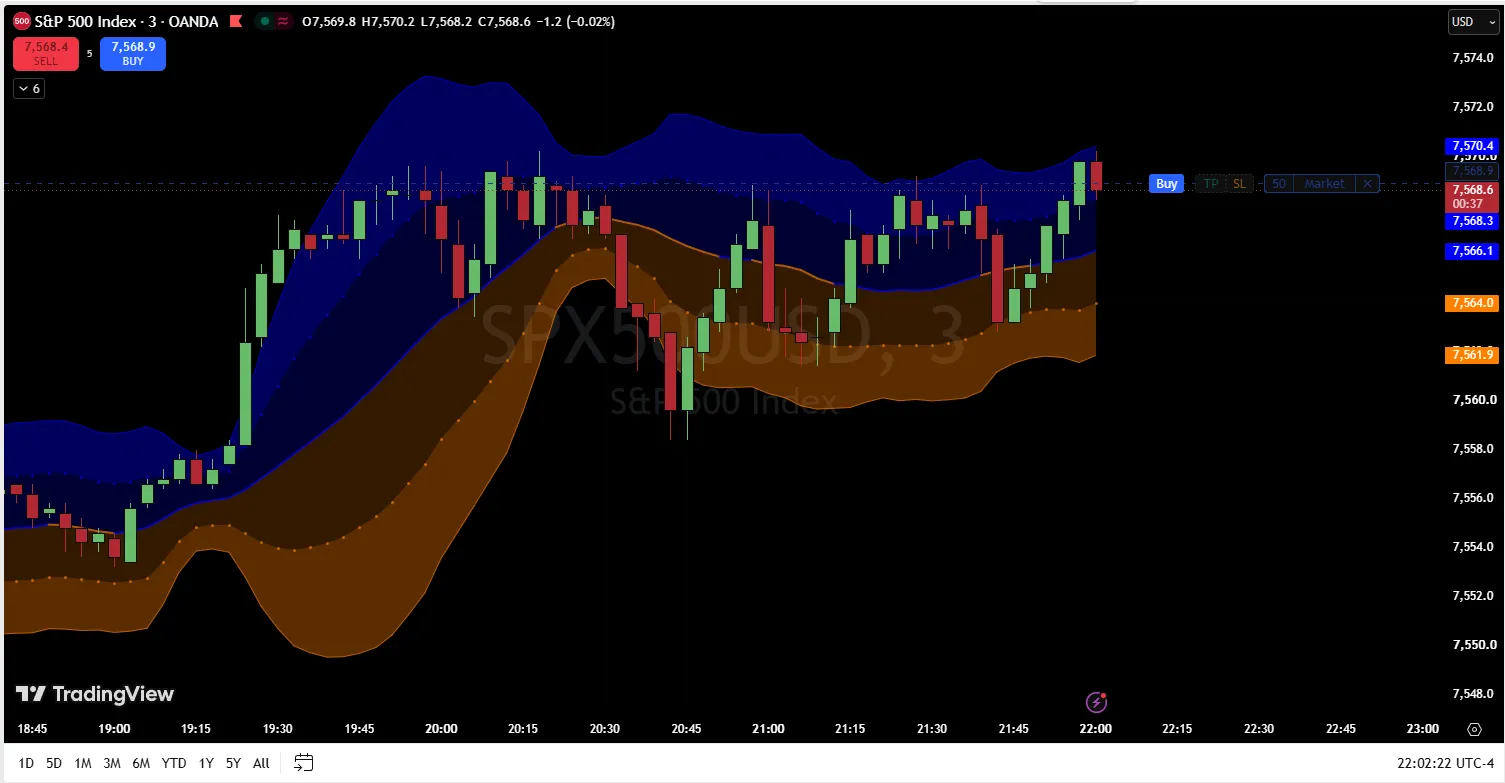
The name is still a work in progress, but the idea is pretty simple. During the quieter hours of the Asian session, I’m looking for a tight, flat consolidation range. When price reaches one of the absolute edges of that range, I’m watching for temporary exhaustion — an attempt to break outside the range that ultimately fails.
The trade comes after confirmation that the breakout attempt didn’t hold.
I’m keeping things intentionally simple at the moment:
- I’m trading only the 3-minute chart.
- I’m looking for a failed break at the edge of a tight range.
- I’m entering after confirmation that price has rejected the breakout.
- My first target is around half of the range.
- My final target is the opposite side of the range.
- I’m currently telling myself to use two MES contracts per trade.
This isn’t a finished system, and it definitely isn’t a signal. It’s simply the strategy I’m testing right now to see whether it makes sense for me, whether I can execute it consistently, and whether I can stay disciplined when the results aren’t immediately rewarding.
The part I’m actually working on
The technical side of a strategy is only one part of trading. The harder part for me is trusting the plan enough to follow it — especially after a couple of losses in a row.
It’s easy to feel confident when the last few trades worked. It’s much harder to stay calm when the strategy gives you a losing streak and your brain starts asking whether you should change everything.
That’s what I’m trying to improve. I want to become the kind of trader who sticks to his plan, gives a strategy a fair chance, and accepts losses as part of the process instead of treating every loss like proof that the whole idea is broken.
Right now, the goal of my paper trading is to simulate what it would feel like to pass evaluations for $25K accounts. I’m not rushing toward that. I want to build the habits first and see if I can follow the rules when there’s nothing real on the line.
Why I’m writing all of this down
At this point, I don’t have a perfect long-term plan for the journal. I just know I want to share the learning experience with other people who are also struggling to get started, choose a strategy, or figure out what actually fits their life.
There’s a lot of trading content that makes the process look effortless. I’d rather document the less polished version — testing ideas, second-guessing myself, taking losses, and slowly learning how to make decisions with a little more patience.
Trade in Progress is going to be exactly that: progress, but not always in a straight line.
For now, I’m back at the charts, paper trading MES during the Asian session, and seeing whether The Tokyo Pipeline can become a process I genuinely trust.
One session at a time.
If you want to follow the next session, you can read the journal entries.